The American Memorial Day holiday used to simply mean the beginning of summer to me. This US holiday (formerly "Decoration Day") came about after the Civil War as a day to decorate the graves of those who died at war. When I came to this country, I quickly learned that to most Americans, summer officially starts with Memorial Day, the last Monday in May, and ends with Labor Day, the first Monday in September. If I asked wasn't Labour Day on the 1st of May, I was told "well, that's communist!" -- few Americans know that May Day (a.k.a. International Workers Day) is the commemoration of the 1886 Haymarket affair in Chicago.
But I digress. To me, Memorial Day is no longer merely the beginning of the summer camping season. Exactly a year ago, a young friend of our family tragically died in an alcohol-related incident on a Memorial Day camping trip. Fletcher and my son had met and become best friends in Kindergarten when we first moved here some 13 years ago. After Kindergarten, the two boys went to different schools, but continued their friendship -- although gradually drifting apart over time. This May, Fletcher would have graduated from High School.
I cannot approach to understand what grief his parents must be feeling every single day since that tragic day. We were on our annual Memorial Day weekend camping trip when we heard the news a year ago. In fact, we were at Summit Lake, the same spot we had once spent a wonderful weekend camping together with Fletcher's family 10 years ago.
I have fond memories from that trip: the weather was amazingly sunny (it was actually hot, well maybe it reached 80F that day)-- the kids even went splashing in the lake! Fletcher and Wulfi were playing at our campsite "climbing" young spruce trees until they completely bent over: the boys would disappear and the tree bounce back! The two of them could keep themselves occupied for hours with imaginary play, and they were mostly pretty good about including "little" sis in their games. I remember how Wulfi and Fletcher would make their own swords, bows and arrows (sometimes even appropriating bamboo poles from my gardening supply). I also sewed quite a few props for their games back then: capes, quivers, and sheaves for their wooden swords...
Now that innocent age seems long gone. I'm just filled with sorrow when I reflect on how Fletcher's parents don't get to see their son grown and go off into the world. All they have left now are memories. I wish I wasn't at such a loss on how to reach out to them on this anniversary of his death -- I know it's difficult for them to be around our family when our children are such painful reminders of their loss.
God bless Fletcher's family on this Memorial Day.
Showing posts with label Reflections. Show all posts
Showing posts with label Reflections. Show all posts
Sunday, May 27, 2012
Sunday, March 25, 2012
Winter Blahs
It's been a year since I last posted! Where did the time go?
Well, since this blog is just a hobby, I never feel obliged to blog if I don't feel like it -- so, yes, I got bored with it (as often happens after a year or two), and, well, LIFE got in the way. This last year was busy, crazy & full of stress factors (health and otherwise) -- perhaps someday I will blog about them, and perhaps not...
We're past the Spring Equinox, but it still looks like winter. Everybody is TIRED of SNOW. We've had near record-breaking cold and snowpack this past winter-- anybody who doubts that spring will ever get here -- patience! THE SUN IS OUR FRIEND and always wins this time of year. Just look at the clear blue sky and feel that solar power: it's bound to melt all that snow before long-- June, July?!!!
I leave you with a picture of a bunch of kids (my own plus a few borrowed ones) on a Nature Center outing several years ago: we're on the frozen Eagle River in mid to late March -- the peak in the middle is Polar Bear Peak.
Well, since this blog is just a hobby, I never feel obliged to blog if I don't feel like it -- so, yes, I got bored with it (as often happens after a year or two), and, well, LIFE got in the way. This last year was busy, crazy & full of stress factors (health and otherwise) -- perhaps someday I will blog about them, and perhaps not...
We're past the Spring Equinox, but it still looks like winter. Everybody is TIRED of SNOW. We've had near record-breaking cold and snowpack this past winter-- anybody who doubts that spring will ever get here -- patience! THE SUN IS OUR FRIEND and always wins this time of year. Just look at the clear blue sky and feel that solar power: it's bound to melt all that snow before long-- June, July?!!!
I leave you with a picture of a bunch of kids (my own plus a few borrowed ones) on a Nature Center outing several years ago: we're on the frozen Eagle River in mid to late March -- the peak in the middle is Polar Bear Peak.

Monday, March 21, 2011
Parenting and Economic Incentives
We recently watched the movie Freakonomics, which I found quite interesting.
Economist Stephen Levitt and journalist Steven Dubner (there is also a book and a Freakonomics blog) study how economic incentives influence human behavior?
Sin taxes have been around for a long time, such as the cigarette tax to influence people to smoke less. Positive incentives abound too: remember tax credits for installing solar panels after the first energy crisis in Billy Carter days, or more recently, health care plans offering rewards if you join a gym...
One of the experime nts done in "Freakonomics" was to see if paying money for good grades (an economic incentive) would work to improve school performance of 9th graders who were failing.
The experiment was set up by the Economics Dept of the University of Chicago: the students were paid $50 if they kept all their grades at C and above, plus a chance to win an even bigger prize ($500) plus a classy limousine ride.
Interestingly enough, the program did not work as well as some might have expected. There were some improvements in grades, but really not as much as they predicted/hoped. The researchers were wondering if perhaps it was already too late for these 9th-graders -- would the experiment have worked better in elementary school? Is it even the right approach?
It made me wonder about the role of incentives in parenting -- how much do parents use incentives in raising their kids? And is it even a good idea?
We all have heard not only of parents that pay for chores and good grades, but even earlier in life, use candy as rewards for everything from potty-training to eating broccoli.
I call that "bribing", and I personally do not think it is such a good idea. Why -- what's wrong with a little bribery? OK, maybe a "wee" little bit, occasionally, is probably ok. But what if it's overused? Do incentives rob kids of the chance for self-motivation?
Kids start expecting something (money, candy) for things that really should be done as a matter of course -- eating your vegetables, clearing the dishes, doing your homework -- isn't that simply part of being a member of family/society?
True, when first introducing a toddler to something new, like potty-training, parents often resort to incentives. The Freakonomics team told the story of potty-training Levitt's 3-year-old daughter: M&M's for going on the potty. Sure, for the first 3 days it worked like a charm, but smart little Amanda had soon learned to game the system: a few dribbles for a handful of M&Ms, then back to the potty for a few more dribbles... you get the idea! The incentive program had back-fired: the parents had become a slave to the M&M payment system.
So what's a desperate parent to do? For potty-training it's probably pretty harmless to try incentives (I remember we used stickers at some point) -- as with so many things in life, when the kid is ready, he/she will start using the toilet (Digression: I remember a Kindergarten teacher once reassuring me that she's never had a child arrive in her class in diapers: "Honey, your kid will get there, eventually, on his own!").
But what about later in life? Especially during the tweens and teens? How can parents motivate them to "do the right thing?", especially when the kids seem to be immune to parental words of wisdom and/or even pleading? If you ask your teen to help clean the house or car before grandma gets picked up at the airport, and they won't do it unless there is compensation negotiated first, then something is wrong in how that family works.
Like the researchers in the Chicago experiment mentioned above, effective parenting needs to have started at a much younger age!
A friend with a toddler asked my husband and I recently about how we raised our kids -- did we use incentives? Not much at all, we realized, other than perhaps the incentive of love & praise. Kids naturally want to please their parents, and if they are rewarded for doing the right thing ("Thank you", "You're such a big help", "I'm so proud of you."), that seems to work well in most cases. Admittedly, raising children is not always smooth sailing -- sometimes there are situations where material incentives might well be appropriate.
Remember when the toddler wanted to help with everything, and you know that it will end up a great deal messier than if you just did it by yourself? Somewhere along the line, their eagerness to help disappears, becoming "work" rather than "fun". Getting the kid to pitch in becomes a battle of wills, bribes, and punishments in some families -- what happened?
In an ideal world, parents can raise their children with the expectation that this is what family members do to help each other out. They've made it about love, trust, cooperation, rather than about "what will I get out of it?". I'm not saying it's always easy, but it's certainly worth trying to start without material incentives!

I'm afraid that using candy and money for incentives leads to selfishness. And in my book, raising a child that think first about "How's that going to benefit me?" is not a good thing -- unless of course they're headed for Wall Street...
Photocredits:
Encefalus.com
washingtonindependent.com
Economist Stephen Levitt and journalist Steven Dubner (there is also a book and a Freakonomics blog) study how economic incentives influence human behavior?
Sin taxes have been around for a long time, such as the cigarette tax to influence people to smoke less. Positive incentives abound too: remember tax credits for installing solar panels after the first energy crisis in Billy Carter days, or more recently, health care plans offering rewards if you join a gym...
One of the experime
 nts done in "Freakonomics" was to see if paying money for good grades (an economic incentive) would work to improve school performance of 9th graders who were failing.
The experiment was set up by the Economics Dept of the University of Chicago: the students were paid $50 if they kept all their grades at C and above, plus a chance to win an even bigger prize ($500) plus a classy limousine ride.
Interestingly enough, the program did not work as well as some might have expected. There were some improvements in grades, but really not as much as they predicted/hoped. The researchers were wondering if perhaps it was already too late for these 9th-graders -- would the experiment have worked better in elementary school? Is it even the right approach?
It made me wonder about the role of incentives in parenting -- how much do parents use incentives in raising their kids? And is it even a good idea?
We all have heard not only of parents that pay for chores and good grades, but even earlier in life, use candy as rewards for everything from potty-training to eating broccoli.
I call that "bribing", and I personally do not think it is such a good idea. Why -- what's wrong with a little bribery? OK, maybe a "wee" little bit, occasionally, is probably ok. But what if it's overused? Do incentives rob kids of the chance for self-motivation?
Kids start expecting something (money, candy) for things that really should be done as a matter of course -- eating your vegetables, clearing the dishes, doing your homework -- isn't that simply part of being a member of family/society?
True, when first introducing a toddler to something new, like potty-training, parents often resort to incentives. The Freakonomics team told the story of potty-training Levitt's 3-year-old daughter: M&M's for going on the potty. Sure, for the first 3 days it worked like a charm, but smart little Amanda had soon learned to game the system: a few dribbles for a handful of M&Ms, then back to the potty for a few more dribbles... you get the idea! The incentive program had back-fired: the parents had become a slave to the M&M payment system.
So what's a desperate parent to do? For potty-training it's probably pretty harmless to try incentives (I remember we used stickers at some point) -- as with so many things in life, when the kid is ready, he/she will start using the toilet (Digression: I remember a Kindergarten teacher once reassuring me that she's never had a child arrive in her class in diapers: "Honey, your kid will get there, eventually, on his own!").
But what about later in life? Especially during the tweens and teens? How can parents motivate them to "do the right thing?", especially when the kids seem to be immune to parental words of wisdom and/or even pleading? If you ask your teen to help clean the house or car before grandma gets picked up at the airport, and they won't do it unless there is compensation negotiated first, then something is wrong in how that family works.
Like the researchers in the Chicago experiment mentioned above, effective parenting needs to have started at a much younger age!
A friend with a toddler asked my husband and I recently about how we raised our kids -- did we use incentives? Not much at all, we realized, other than perhaps the incentive of love & praise. Kids naturally want to please their parents, and if they are rewarded for doing the right thing ("Thank you", "You're such a big help", "I'm so proud of you."), that seems to work well in most cases. Admittedly, raising children is not always smooth sailing -- sometimes there are situations where material incentives might well be appropriate.
Remember when the toddler wanted to help with everything, and you know that it will end up a great deal messier than if you just did it by yourself? Somewhere along the line, their eagerness to help disappears, becoming "work" rather than "fun". Getting the kid to pitch in becomes a battle of wills, bribes, and punishments in some families -- what happened?
In an ideal world, parents can raise their children with the expectation that this is what family members do to help each other out. They've made it about love, trust, cooperation, rather than about "what will I get out of it?". I'm not saying it's always easy, but it's certainly worth trying to start without material incentives!

I'm afraid that using candy and money for incentives leads to selfishness. And in my book, raising a child that think first about "How's that going to benefit me?" is not a good thing -- unless of course they're headed for Wall Street...
Photocredits:
Encefalus.com
washingtonindependent.com
Monday, November 8, 2010
Where the witches dance

Every morning here in Germany I head into the forest behind my parents' home and take a brisk walk. I love being alone in the woods, inhaling the scent of decaying fall foliage, (as opposed to the car exhausts on the streets and Autobahn) . As I walk/jog along, I pass several old bomb craters from WW2 and remains of old bunkers, a reminder of the many battles fought along the German-French border.
There are lots of different paths in these woods, but they all lead to a clearing called the "Hexentanzplatz" (where the witches dance), which also features an old stone monument from the time of the Romans. I' m amazed at all the history I'm surrounded by -- every piece of ground here has been inhabited, and probably fought over, for thousands of years.
An American who lives here told me this story: A German was telling her about a building that was very old, bragging "This is older than your country!". She jokingly retorted something along the line of "What if I don't care?". The German responded with "See, that right there is the problem with you Americans!"
Well, I am in awe of all the history that surrounds me here in Germany -- but I can also see how history/tradition/religion/culture can be used as an excuse for not changing, for hanging on to old prejudices. When I recently spoke with a cousin who is rather unconventional, she quibbed "During the Middle Ages they would have burned me as a witch!" I thought that was a strange thing to say, not something that I give much thought to in my daily life. On a tour of a nearby town the next day she pointed out a basket suspended above the river that was used to dunk witches or other dissenters until they drowned (if they survived it was considered proof of sorcery, and if they didn't, o well!).
There are lots of different paths in these woods, but they all lead to a clearing called the "Hexentanzplatz" (where the witches dance), which also features an old stone monument from the time of the Romans. I' m amazed at all the history I'm surrounded by -- every piece of ground here has been inhabited, and probably fought over, for thousands of years.
An American who lives here told me this story: A German was telling her about a building that was very old, bragging "This is older than your country!". She jokingly retorted something along the line of "What if I don't care?". The German responded with "See, that right there is the problem with you Americans!"
Well, I am in awe of all the history that surrounds me here in Germany -- but I can also see how history/tradition/religion/culture can be used as an excuse for not changing, for hanging on to old prejudices. When I recently spoke with a cousin who is rather unconventional, she quibbed "During the Middle Ages they would have burned me as a witch!" I thought that was a strange thing to say, not something that I give much thought to in my daily life. On a tour of a nearby town the next day she pointed out a basket suspended above the river that was used to dunk witches or other dissenters until they drowned (if they survived it was considered proof of sorcery, and if they didn't, o well!).
Sunday, November 7, 2010
Taking care of friendships
There is a German expression: "Freudschaften pflegen" which translates loosely to taking care of friendships. But the word pflegen (=caring) implies a level of care that is more along the line of nursing or even healing. And indeed, Germans do treat friendships very differently from mere acquaintances ("Bekanntschaft" in German).
Blogger Amiexpat wrote recently about making friends in Germany, and I found the discussion very interesting. Americans are quick to make friends while Germans take it very slow and steady -- it often takes years before they decide to use first names and use "Du" instead of the formal "Sie". It is also true in both countries that as we get older we have a more difficult time making friends -- for some people in both the US and Germany, the only close friendships are those made in school/university years. I think that is sad: especially given how much more mobile society is becoming, many become lonelier as friends move away or pass on.
I have not always been good in the "Freundschaft pflegen" department: not only have I moved a lot, but have not been the best at correspondence or picking up the phone. Facebook has helped me (and many others) reconnect with old friends who we've lost touch with -- but Facebook per se is no substitute for friendships, but only a first step in re-connecting.
Yesterday I had the wonderful opportunity to spend a day with an old highschool friend from the Philippines. We had found each other on Facebook after some 30-odd years, and since she lives in Belgium now, we we able to meet up during my Germany visit. It was GREAT-- we found that we had a great deal in common (besides our gray hair we both refuse to dye). Sometimes old friends grow apart over time (becoming fundamentalist Christians, greedy businessmen/women, or even Tea Party Republicans) -- but luckily my friend is none of those!
And now I've got some serious Belgian chocolate to haul back in my suitcase. Thanks Meg!
Blogger Amiexpat wrote recently about making friends in Germany, and I found the discussion very interesting. Americans are quick to make friends while Germans take it very slow and steady -- it often takes years before they decide to use first names and use "Du" instead of the formal "Sie". It is also true in both countries that as we get older we have a more difficult time making friends -- for some people in both the US and Germany, the only close friendships are those made in school/university years. I think that is sad: especially given how much more mobile society is becoming, many become lonelier as friends move away or pass on.
I have not always been good in the "Freundschaft pflegen" department: not only have I moved a lot, but have not been the best at correspondence or picking up the phone. Facebook has helped me (and many others) reconnect with old friends who we've lost touch with -- but Facebook per se is no substitute for friendships, but only a first step in re-connecting.
Yesterday I had the wonderful opportunity to spend a day with an old highschool friend from the Philippines. We had found each other on Facebook after some 30-odd years, and since she lives in Belgium now, we we able to meet up during my Germany visit. It was GREAT-- we found that we had a great deal in common (besides our gray hair we both refuse to dye). Sometimes old friends grow apart over time (becoming fundamentalist Christians, greedy businessmen/women, or even Tea Party Republicans) -- but luckily my friend is none of those!
And now I've got some serious Belgian chocolate to haul back in my suitcase. Thanks Meg!
Wednesday, October 13, 2010
Technology catches up with an old lady...
If it weren't for our kids, I'd probably be completely stuck in the last century, like using paper and pen to communicate!
We now took the BIG plunge and became an i-phone family. Youngest is turning 13 this week, and is ready for her very own cell phone -- and this forced the issue we had been debating for a while: "to switch or not to switch?"
Well, we did switch! Now the whole damn family has i-phones, and we can not only call or text, but also check emails, surf the web, facebook, listen to i-tunes, navigate using GPS location/street maps, take and share photos...
Our oldest daughter spent the last 6 months hiking the PCT, and I've been amazed at what all she can do per i-phone, even posting entries on her blog! Hubby pointed out to me that i-phones are the equivalent of a digital Swiss Army knife: one tool does everything. Nifty!
Now, I need to learn how to use it!!! Luckily, I got kids...
PS (very embarrassing): I only learned to retrieve text messages on my old cell phone yesterday -- I've got a long way to go....
We now took the BIG plunge and became an i-phone family. Youngest is turning 13 this week, and is ready for her very own cell phone -- and this forced the issue we had been debating for a while: "to switch or not to switch?"
Well, we did switch! Now the whole damn family has i-phones, and we can not only call or text, but also check emails, surf the web, facebook, listen to i-tunes, navigate using GPS location/street maps, take and share photos...
Our oldest daughter spent the last 6 months hiking the PCT, and I've been amazed at what all she can do per i-phone, even posting entries on her blog! Hubby pointed out to me that i-phones are the equivalent of a digital Swiss Army knife: one tool does everything. Nifty!
Now, I need to learn how to use it!!! Luckily, I got kids...
PS (very embarrassing): I only learned to retrieve text messages on my old cell phone yesterday -- I've got a long way to go....
Friday, October 8, 2010
Is Yoga Un-christian? and who cares...
A Baptist minister has been making news lately with his assertion that the practice of yoga is un-christian. Reverend Albert Mohler, the president of the Southern Baptist Theological Seminary, warns Christians of failing to see the "contradictions between their Christian commitments and their embrace of yoga."
How narrow-minded! As if anything that does not come down directly from the bible is automatically circumspect. I'm often aghast at the intolerance of many Americans toward non-Western culture (just look at how they treat muslims!) And this is especially strong among evangelical Christians who look at everything through just one filter, namely the bible. Rather than seeing humanity and communality between cultures, they see only "Either you're with us, or against us". How is that going to make for a better world? How arrogant to think that your world view is the only correct one!
In an article at the Huffington Post, "Calm Down Christians, Yoga is Not a Thread", author and interfaith minister Philip Goldberg traces over 100 years of history of how yoga has been perceived in America: Mohler is not the first American to warn of dire consequences! Still, the vast majority of yoga practitioners aren't doing it for any particularly religious reasons (nor are they about to be converted to Hinduisn) -- rather, it's a form of exercise with a spiritual component.
I go to yoga, and I don't go to church.
Those are not connected!
How narrow-minded! As if anything that does not come down directly from the bible is automatically circumspect. I'm often aghast at the intolerance of many Americans toward non-Western culture (just look at how they treat muslims!) And this is especially strong among evangelical Christians who look at everything through just one filter, namely the bible. Rather than seeing humanity and communality between cultures, they see only "Either you're with us, or against us". How is that going to make for a better world? How arrogant to think that your world view is the only correct one!
In an article at the Huffington Post, "Calm Down Christians, Yoga is Not a Thread", author and interfaith minister Philip Goldberg traces over 100 years of history of how yoga has been perceived in America: Mohler is not the first American to warn of dire consequences! Still, the vast majority of yoga practitioners aren't doing it for any particularly religious reasons (nor are they about to be converted to Hinduisn) -- rather, it's a form of exercise with a spiritual component.
I go to yoga, and I don't go to church.
Those are not connected!
Thursday, July 15, 2010
No TV?!? Dude, you're weird!
We're having a great summer here. Cool, but not too rainy. Kids are keeping busy, outdoors and indoors, and they're getting along great (for the most part). And they're not watching any TV.
Just picked up Youngest from Music Camp yesterday.
She related this comment from a fellow camper, upon hearing there's no TV in her life:
"No TV, really? Do you have X-Box? Wii?"
"No."
"Dude, you're weird!"

Photo credit: http://www.rebelart.net
The Prof, a.k.a. husband, just got back from a conference, and he too had a conversation with a fellow "camper" about our TV-free household:
"I bet you don't have any kids."
"Actually, I do. Teens."
"What do they think of not having any TV!?!"
"They're jiggy with it."
And indeed, our kids are truly fine without a TV, never having had one around -- and they wouldn't want it any other way. They to get to watch movies on DVD (we even have BluRay, so we're not entirely last-century), but they don't feel like they're missing out on anything by not having cable or network TV.
HONEST. It is possible to raise kids without TV!
Just picked up Youngest from Music Camp yesterday.
She related this comment from a fellow camper, upon hearing there's no TV in her life:
"No TV, really? Do you have X-Box? Wii?"
"No."
"Dude, you're weird!"

Photo credit: http://www.rebelart.net
The Prof, a.k.a. husband, just got back from a conference, and he too had a conversation with a fellow "camper" about our TV-free household:
"I bet you don't have any kids."
"Actually, I do. Teens."
"What do they think of not having any TV!?!"
"They're jiggy with it."
And indeed, our kids are truly fine without a TV, never having had one around -- and they wouldn't want it any other way. They to get to watch movies on DVD (we even have BluRay, so we're not entirely last-century), but they don't feel like they're missing out on anything by not having cable or network TV.
HONEST. It is possible to raise kids without TV!
Wednesday, June 30, 2010
How to tell people I blog

I've been blogging for a while now, and enjoy it!
I started with the idea of keeping far-away friends and family posted on what's going on in my life (and in my head), but blogging has become something I'm doing because I enjoy writing, for myself, for the sake of writing: getting words on cyber-paper JUST BECAUSE. I write 2 blogs actually, and it's more likely the recipe/food blog that I might mention. But when I tell a friend or co-worker "the recipe is on my blog", I often get a funny look or stunned silence -- why that reaction to blogging?
I read a recent post on this subject by Ian (a Canadian living in Hamburg, Germany) who's blog is called Letters Home to You. I enjoy reading it, and he recently posted "How to tell people you're a blogger".
I know it’s not as if I’ve grown a second head or have one of those dumb-looking disks dangling from my earlobes, but still I hesitated before telling them. ...None of it needs any justification, rationalisation or explanation. It is what it is. So yeah, I’ve been blogging, but I’m still OK.I do so agree with him. Blogging needs no justification. It's a personal choice, a hobby.
Some people scrapbook, others write letters to the editor of the local newspaper. Some people like to forward emails to everybody whenever they come across a funny picture or a worthwhile cause. Others post frequently on twitter or facebook, or post snapshots on picasa or blipfoto. Some people blog...
What I enjoy is having found an outlet for writing, for ideas, for discussing what matters to me, such as the environment, or good food! A lot is about my family, and perhaps that interests nobody but my family -- fair enough! Nobody has to read my blog -- hey, it's o.k. by me.
I blog because I enjoy it. PURE AND SIMPLE.
photocredit: http://www.gigglepoetry.com/poem_illustrations/405.jpg
accompanying the poem'The Two-headed Monster" by Darren Sardelli
Thursday, May 20, 2010
When I'm old...
Youngest (a young woman now!) is very aware of time and passages right now -- today is her last day of childhood, or at least, of elementary school. She graduates from 6th grade today and is then officially in Junior High!
She told me the other day: "When I'm old, like 50, I want to be like you. And also like my teacher, Mrs.A -- she's training for a 50 K now. For both of you, exercise and health are important, and you don't feel old. That's how I want to be!'"
What a compliment!
I turn 50 this year (disclaimer: I am not training for a 50K), but I do keep active, and I certainly don't feel OLD.
Digression: My grandmother, when she turned 50, stopped wearing a bathing suit in public! She would have considered it "indecent exposure"!

Photo credit: http://wolfeyebrows.files.wordpress.com/2009/12/lady-in-her-swim-suit.jpg
She told me the other day: "When I'm old, like 50, I want to be like you. And also like my teacher, Mrs.A -- she's training for a 50 K now. For both of you, exercise and health are important, and you don't feel old. That's how I want to be!'"
What a compliment!
I turn 50 this year (disclaimer: I am not training for a 50K), but I do keep active, and I certainly don't feel OLD.
Digression: My grandmother, when she turned 50, stopped wearing a bathing suit in public! She would have considered it "indecent exposure"!

Photo credit: http://wolfeyebrows.files.wordpress.com/2009/12/lady-in-her-swim-suit.jpg
Wednesday, May 19, 2010
Semantics: Naturist vs. Naturalist
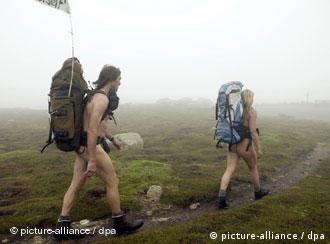 My job title is Naturalist, which is defined as an expert in Natural History.
Not to be confused with Naturist, which is somebody who likes to go nude, i.e. wear no clothes.
Today's Anchorage Daily News has an article about Nude hiking in Alaska -- not exactly a trend I see catching on big-time, given our state's abundant crop in mosquitoes...!
But I better be extra clear, pronunciation-wise, when I describe myself as a naturalist. And specify that I do wear clothes, which naturists refer to as "textiled".
Picture Credit: http://www.dw-world.de
accompanying article that reports nude hiking has been banned in the Swiss Canton of Appenzell.
Wednesday, March 10, 2010
Homeschooling -do children benefit?
 It's Spring Break, we just got a bunch of new snow, and the kids are relishing their mini vacation: a full week of sleeping in every morning, goofing around with each other, skiing, sledding, and generally enjoying the absence of structured school days. But do they ever wish they were home-schooled?
Alaska has a fairly high percentage of homeschooled children -- due in part to remoteness, rugged individualism, religious freedom issues, or perhaps because the state has some of the most lax rules (See ADN Homeschool: Making the Grade?). In fact, there is even a whole "unschooling" movement which believes in child-centered learning (see more here).
I've been wondering, is home-schooling good for children? This may seem like a loaded question -- but I don't mean to "attack". I just honestly wonder about home-schooling, and how these children fare later in life.
May I first of all say that all children should (and do) learn at home. Home/parents/family are a child's first and foremost influence in life, and hopefully, it's not only a loving environment, but also a place to learn. Children learn by watching parents, by playing, by helping (baking cookies, gardening, fixing the lawnmower)...
My children, as I said, are not home-schooled. Honestly, I've never even considered it. I grew up going to schools, public and private, in several different countries. Formal education was highly valued by my family, and by German society as a whole (in fact, Germany requires all citizens of a certain age, something like ages 6-18, to attend school, and it is illegal in Germany for parents to keep them at home). This is very different from the US, where over 2 million children are home-schooled.
At my job, I often meet home-schooled families, who seek out our nature education programs to complement their home studies. Some of the children are amazing: motivated, engaged, curious, and very sweet. Some seem poorly socialized, disruptive or extremely timid. Many seem poorly prepared, especially when it comes to math and science past about 5th grade -- yet others are little geniuses, bright and way ahead of their peers in public schools.
The parents of home-schooled children also vary widely. I've met wonderful parents who seem to be doing a great job and are very engaged in their children's education, even raising them bi-lingually (something I never did manage with my brood!). Yet I've also met a few demanding and unpleasant parents, who feel that their children are superior to regularly-schooled children, and demand special treatment (such as not having to pay or expect us to teach science without any mention of evolution)!
Why home-school? For some families it seems to be special circumstances, such as a handicapped child, and the parents fear that he/she will not be served well by the school system. Some families home-school on account of odd travel or work schedules, allowing fathers to spend more time with their children when they're home. For some, a bad experience (or even a parent's bad memory of their own schooling) leads to an abandonment of formal education. And of course, there are parents who have strong philosophical/religious reasons for wanting their children away from mainstream formal education -- in other words, sheltering their children from what they perceive is negative about the world at large.
Home-schooling takes tremendous dedication and patience. Families with several children are especially challenged to provide a good education for ALL their children -- sadly some of the older children seem to be getting less attention when the bulk of the effort shifts to the younger ones. Unless an older child is very motivated, big gaps in their education may develop. For example, I took a 17-year old home-schooler under my wing a number of years ago: she was very interested in biology and ecology -- but because she was given the freedom to only focus on what interested her (and that did not include physical sciences such as chemistry), she ended up with problems understanding basic biological processes. She did pursue a college degree, but it took her much more time to "catch up" and get up to speed -- making her college degree a longer, and much more expensive, pursuit (4 extra years meant, in effect, having to repeat high school in college).
One big concern I have for older home-schooled children is the lack of real-world experiences, especially in the social realm. They often lack social skills (and I'm not talking about manners -- in fact, they're usually plenty polite around adults). These children may have experienced group dynamics in Sunday School and summercamp settings, but they often lack experience in dealing with people outside their own social circles. They may be naive, never having had exposure to cultural or racial diversity, or meeting people who come from different backgrounds economically or culturally. And they can be clueless when it comes to dealing with interpersonal conflict, never having had much practice in dealing with such problems. I don't mean to imply that conventionally-schooled children are automatically more socially adept, but chances are they're more likely to have had a wider range of exposure and practice than highly-sheltered kids. Parents don't relish having to prepare their children to deal with bullies or other unpleasant people in life -- but sooner or later, we all are faced with them.

Home-school parents often have very strong personal views about religion, morality, etc. and they pass these to their children. Not that this is a bad thing per se-- a parent's job is to provide a moral compass and thus to give their children a strong foundation. But no matter how nice the parents are, as the children are growing into young adults, they do need more than just their parents' take on the world in order to be prepared for the real world, especially as they get older. Personally, I think this needs to start before children enter their teenage years.
I think it's a disservice to limit ones' children exposure to the extend that they're lost when they do get out in the real world. I suppose that ultimately this is the biggest challenge of raising kids: preparing them for being on their own someday. Homeschooling parents may argue that there is no hurry in sending their children into the real world -- so I ask, when do they plan to let their children go & trust them to negotiate life on their own: at 20? at 30?
Which brings me to my biggest concern: that home-schooled children often lack something that I value very much: critical thinking. If a person is never exposed to intellectual discourse during the course of their education, when/where will they learn it? Many home-schooled children probably get very little experience in debating different viewpoints, in listening to (and considering the merits of) other ideas. I wonder how many home-schooled children fall into one of two extreme camps as they get older -- either they end up strongly rebelling against everything their parents stand for, or alternatively, they adapt their parents' (pre-set) worldview as their own, unquestioningly, without a chance to form their own unique worldview?
So, here's what I wonder: Where do children learn openmindedness, tolerance, perspective?
I think it's best as a combination of home and school, or another way of saying that, it's got to be a combination of learning from parents and non-parents.
Isn't there some sort of saying somewhere about parenthood not being about raising a child as one own's, but rather that the child is on "loan" for only for a short while, but ultimately, the child never truly "belonged" to the parent.
I like to think that the prof (my husband) and I do a decent job of guiding our children through life -- and we strongly believe in spending a lot of quality time together -- but we do value formal education (we're educators/academics after all!). Despite the fact that we both have advanced degrees, neither of us feel adequately prepared to give our children a well-rounded education, especially at the secondary level (even if the prof and I had the sciences covered, read a lot of literature, speak another language and appreciate art and music, we still feel there's still a great deal more to education).
I recently a discussion about homeschooling with the younger 2 children, and they both agreed:
"Even though you guys are both great teachers, we're so glad we get to go to regular school -- our lives are so much richer than if we'd been home-schooled."
Thursday, February 18, 2010
What religion am I?
Today I came across an unusual, interesting website, called Beliefnet.
I took a quiz to find out just where my religious views fit. I was surprised how thorough and thought-provoking the questions were, and liked the fact that I was asked to weigh the importance (low-high) of each question. It starts asking about concepts God, afterlife, human nature, but goes into moral issues too. Like I said, I found it more thorough than most quizzes of the "20 questions" variety...
The top 3 that came up for me were:
Liberal Quakers
Unitarian Universalism
Neo-Paganism
The first 2 did not surprise me at all (that's pretty much what I had figured), but the third came as a bit of a surprise -- I suppose it has to do with my love for nature, rather than any Wiccan tendencies hidden deep in my soul...
On the very bottom of the list (which basically ranks how much your view match with over 20 religions), I found out that I match the very least with the Roman Catholic Faith. That did not surprise me either, but I do still have a a great deal of respect for RC and other traditional/orthodox religions. That is, if they truly follow Jesus Christ's teachings, concentrating on things like love, and fight for social justice rather than stupid things like opposing gay marriage...
When asked to describe her religion on her Facebook profile, a friend of mine put "Religious no, spiritual yes", which I think describes me too.
I do care deeply about many things, and do believe in some sort of supreme force or Ultimate Truth, but am not too worried about details. I think there are many paths to God, and that no one religion or belief system holds a monopoly on truth or salvation.
What matters to me a great deal is how we treat life on this earth: each other, animals, plants, the environment (and I suppose that makes me a Pagan!? -- for a discussion of the origin and definition of the term "pagan", see this Religious Tolerance website)
If you're curious and want to take the test for yourself, here's the link:
http://www.beliefnet.com/Entertainment/Quizzes/BeliefOMatic.aspx
I took a quiz to find out just where my religious views fit. I was surprised how thorough and thought-provoking the questions were, and liked the fact that I was asked to weigh the importance (low-high) of each question. It starts asking about concepts God, afterlife, human nature, but goes into moral issues too. Like I said, I found it more thorough than most quizzes of the "20 questions" variety...
The top 3 that came up for me were:
Liberal Quakers
Unitarian Universalism
Neo-Paganism
The first 2 did not surprise me at all (that's pretty much what I had figured), but the third came as a bit of a surprise -- I suppose it has to do with my love for nature, rather than any Wiccan tendencies hidden deep in my soul...
On the very bottom of the list (which basically ranks how much your view match with over 20 religions), I found out that I match the very least with the Roman Catholic Faith. That did not surprise me either, but I do still have a a great deal of respect for RC and other traditional/orthodox religions. That is, if they truly follow Jesus Christ's teachings, concentrating on things like love, and fight for social justice rather than stupid things like opposing gay marriage...
When asked to describe her religion on her Facebook profile, a friend of mine put "Religious no, spiritual yes", which I think describes me too.
I do care deeply about many things, and do believe in some sort of supreme force or Ultimate Truth, but am not too worried about details. I think there are many paths to God, and that no one religion or belief system holds a monopoly on truth or salvation.
What matters to me a great deal is how we treat life on this earth: each other, animals, plants, the environment (and I suppose that makes me a Pagan!? -- for a discussion of the origin and definition of the term "pagan", see this Religious Tolerance website)
If you're curious and want to take the test for yourself, here's the link:
http://www.beliefnet.com/Entertainment/Quizzes/BeliefOMatic.aspx
Monday, January 4, 2010
Living greener by eating less meat
 When I was young, I was a vegetarian for many years. Like many young people, I used to think in "black and white" terms: meat was bad, vegetables were good. I had read Frances Moore Lappe's book "Diet for a Small Planet" my first year in college (having just moved to the US after living in a developing country, I was aghast at the waste and conspicuous consumption) -- I became convinced that meat production was a waste of our planet's scarce agricultural resources. By the time I had children I started eating meat again -- in fact I craved it when I was pregnant!
I didn't give all that much thought to how food was raised as I was busy raising and feeding my growing family -- I was thinking less about the environment and more about cooking well-balanced meals and avoiding junk food! But it does turn out that meat production can be very wasteful indeed, and is perhaps becoming more so than when Lappe's book was first written! I'm now coming back around to thinking about those issue again. A big turning point for me was reading Michael Pollen's In Defense of Food and Barbara Kingsolver's Animal, Vegetable, Miracle.
As I've been learning more about where our food comes from, I find I don't care to eat industrially-produced meat, and the alternative (organic, local, wild) is much more difficult and expensive to come by. I have friends here in Alaska who will only eat meat they hunted or caught themselves -- but alas, hubby is not "into" hunting, and our freezer is already out of salmon fillets. ASIDE: in many parts of Alaska, churches and other non-profit organization have volunteers who will process road-killed moose, and the meat is donated to food banks (plus the volunteers get a cut -maybe I need to sign up in order to get some "church moose"?) -- since it is illegal for the driver of the vehicle to simply take home the moose they ran over! EOD, End of Digression.
I'm realizing more and more that not all meat (or eggs and dairy for that matter) is bad -- rather, it can vary greatly. For example, cows are naturally grass-eaters, but in an effort to grow beef faster and faster, they are now fed a diet of mostly corn (which is difficult for them to digest) and thus cattle are given lots of hormones and antibiotics. These are showing up in our drinking water! DNA analysis shows that between corn-fed hamburgers and HFCS (High Fructose Corn Syrup) that's used heavily in processed foods and sodas, Americans are starting to have a food signature that's mostly corn (an interesting movie to see is King Corn)!
The implications of how food is raised have huge impacts not only on the nutritional food value of our food, but on the health of our planet as well. So I'm finding myself eating less and less meat. I'm not a vegetarian, and I do think it's natural for humans to eat meat -- evolutionarily we're omnivores after all -- but yet, I feel less and less like eating industrially-produced meat.
This past year our family has been eating more vegetables, legumes and whole grains, due in part to getting a weekly CSA box full of fresh organic produce! And I must say that I feel healthier and even have lost some of that 40+something weight gain (without even trying -- I certainly am not the "dieting" type (more on that topic on my post Diet is a 4-letter word).
But really, how much meat do we really need to eat? Humans certainly can and do thrive on a mostly vegetarian diet. I admit that while I enjoy a good cut of meat, I find myself less willing to buy what's for sale at the grocery store. Right now I'm reading an interesting book by Nicolette Hahn Niman called Rightous Porkchop (Finding a Life and Good Food Beyond Factory Farms). The more I learn about the food industry, the more I want to get away from industrially-produced meat. I stand there in the grocery store and wonder: did this meat come from a CAFO (Concentrated Animal Feeding Operation) where animals are kept in horrible conditions, standing knee-deep in their own excriments while being fattened on corn products and kept from getting sick only by heavy administration of antibiotics? Were these eggs laid by chickens crammed into barns by the thousands, unable to walk even a few steps? Did the bacon come from pigs produced in a giant warehouse operation that produces more wastewater pollution than a small city?
I do recommend the movie Food, Inc (Santa brought me that for Christmas), which does a good job of reporting on food issues without being overly sensational. It makes a really good point about how we vote on food issues every time we're at the checkout stand of the the grocery store -- as our food purchases get scanned, we VOTE with our dollars: for example, as organic products are making more and more gains in the US/World market, industry is starting to pay attention! Within the last few years, our family has switched first to organic milk, then many of our vegetables, chicken and now also beef. And of course we do love eating our Alaskan Wild salmon!
I'm still working on figuring out eggs -- there are a few with the label "organic" and many more with the less meaningful label "natural". Some brands advertise they're antibiotic and additive-free, vegetarian-fed (= no animal by-products), and even cage-free. But does "cage-free" mean they really get to roam the farmyard, or did they get an itty-bitty "yard" attached to a giant facility that very few of the chickens can even get to? Vegetarian feed is better than ground up recycled dead chicks, but then again, eating bugs is actually an important and normal part of a chicken's diet...
Ideally I'd like to raise our own chickens, but I'm worried about the wildlife factor here: would raising backyard poultry act as an attractant to the many bears (black and brown) that occasionally roam our neighborhood? I wish I could find a good local source of eggs that don't cost an arm and a (chicken)-leg! These last few years I've been buying Wilcoxfarms Omega-3 eggs available at Costco (chickens that are fed grass-based diets do lay eggs that are higher in beneficial omega-3 fatty acids) -- but it's still part of a huge factory-style operation (I think?!) -- but then again, one step at a time: at least they're not as bad as some of the other industrial producers out there...

So here I am, puzzled. I go grocery-shopping (and vote!) every week, and I want to do what's best for my family and for my planet. My boys/men certainly do like their spicy food and meat, while my daughters and I would be happy eating mostly vegetarian. So the compromise I'm making is that I try to cook more and more with organic/local produce, and while I do cook with meat several times a week, I use smaller quantities than I used to. For example, I might use sausage more as a spice than a main ingredient, or make stir-fry or curry with more vegetables than meat. I've learned a couple of things over the last few years:
- change seems easier when it's gradual.
- if I cook too "healthy" and lean, then they eat more snacks/junkfood inbetween meals.
- I am the queen of the kitchen:)
- they will eat what I cook --an awesome power, I know -- and I'll try not to let that get to my head!
Photo credits:
Meat from http://upload.wikimedia.org/wikipedia/commons
Eggs from http://www.zetafarms.com
Saturday, January 2, 2010
New Years Wishes, Reflections, and Pictures
Wishing everyone a very good New Year!
Just cooked up a proverbial storm of New Year's food (recipes at Borealkitchen.blogspot.com).
As is typical for this time of year, it's cold here, with temperatures below zero Fahrenheit. Here are some pictures from yesterday when we drove to the Mat-Su valley. The first part of the drive was in the sunshine (view of Talkeetna Mountains from Chugiak): By the time we got down to the Knik River, we were very much in the fog -- looks cold and grim, doesn't it? It actually is amazingly beautiful, I think -- reminiscent of the Dr. Zhivago, which we just watched -- a tradition for us during the break between Christmas and New Year.
By the time we got to Wasilla, we could see the sun again.


We've entered a new decade -- I hope that it's a better one politically compared to the last. The post 9-11 decade (a.k.a. George W. Bush era) sure seemed full of fear. Fear of terrorists, fear of economic collapse, fear of reform -such as fear of "socialized" healthcare. I say "Bring it on!" I'd like to see healthcare reform continue to be "tweaked" and improved over the next decade or two, and hope that we adopt more and more green energy policies, that we reform agriculture to be more sustainable, and that US foreign policy become less about fighting wars and more about peace-making!
On a more personal level, our famil y has entered our second decade of living in this beautiful valley, and feel very blessed. While we still sometimes miss Fairbanks and Colorado where we lived during the last millenenium, we have grown very fond of this valley. The children are growing into lovely young ladies and gentlemen, and bring us parents much joy and pride. We feel very satisfied in our jobs as well -- we're truly blessed!
Just cooked up a proverbial storm of New Year's food (recipes at Borealkitchen.blogspot.com).
As is typical for this time of year, it's cold here, with temperatures below zero Fahrenheit. Here are some pictures from yesterday when we drove to the Mat-Su valley. The first part of the drive was in the sunshine (view of Talkeetna Mountains from Chugiak):
 By the time we got down to the Knik River, we were very much in the fog -- looks cold and grim, doesn't it? It actually is amazingly beautiful, I think -- reminiscent of the Dr. Zhivago, which we just watched -- a tradition for us during the break between Christmas and New Year.
By the time we got to Wasilla, we could see the sun again.


We've entered a new decade -- I hope that it's a better one politically compared to the last. The post 9-11 decade (a.k.a. George W. Bush era) sure seemed full of fear. Fear of terrorists, fear of economic collapse, fear of reform -such as fear of "socialized" healthcare. I say "Bring it on!" I'd like to see healthcare reform continue to be "tweaked" and improved over the next decade or two, and hope that we adopt more and more green energy policies, that we reform agriculture to be more sustainable, and that US foreign policy become less about fighting wars and more about peace-making!
On a more personal level, our famil
 y has entered our second decade of living in this beautiful valley, and feel very blessed. While we still sometimes miss Fairbanks and Colorado where we lived during the last millenenium, we have grown very fond of this valley. The children are growing into lovely young ladies and gentlemen, and bring us parents much joy and pride. We feel very satisfied in our jobs as well -- we're truly blessed!
Thursday, November 12, 2009

It was my birthday yesterday, and I'm feeling great (despite the fact that the stomach flu is making the rounds in our household -- so far only through the male population!).
True, I'm another year older, but strangely, that does not bother me at all. I don't feel old, even though now I am as close as I can get to the big 5-0 without actually being there yet!
Here's a photo of moi, taken by hubby when we went blueberry-picking this fall. I usually don't like to have my picture taken, as I'm not photogenic at all. But on that particular beautiful fall day, I didn't mind him clicking away...
I'm a really lucky person: I've got a loving family, good health, and live in a really nice place!
I know that it's more luck than earned -- luck to have met and married a wonderful man (I suppose I can take some credit for having at least been at least a decent enough person) , genetic luck in that I have not inherited lousy DNA, and luck that the winds blew our little family to Alaska (the last great frontier!)
What makes me ponder this right now is that I recently received a real good rating when I applied for life insurance -- I got a clean bill of health! Apparently my health history and blood results indicate that I'm at a low risk to keel over from a heart attack anytime soon.
I can thank my parents for good genes -- on my father's side everybody seems to live well into their 80's without any heart problems, cancer, diabetes or Alzheimers. Watch out kids, you may not see any of that life insurance money for at least 30 years!
I'm truly lucky to be healthy. Besides inheriting healthy genes, I suppose I can take a little credit for a reasonably healthy lifestyle. What does that involve? What helps is not smoking or drinking (I do enjoy a glass of wine or beer a couple of times a week, however), sleeping well and not having a stressful life or job, eating reasonably healthy foods, and staying active.
I'm no sports nut, and certainly don't run marathons. But I do manage to be active everyday -- it may not seem much, but at a minimum, I guess I easily get those minimum recommended 20-30 minutes of light aerobic exercise every day. Most days that's just simply walking (lots), but it might also be gardening, snow shoveling or yoga.
Food is something everybody seems to be focused on these days, or even posessed by. Yes, I try to eat reasonably healthy, but I'm no health nut, either. In fact, I have a pretty healthy appetite: I eat a lot, and I have never really g
 one on a "diet". I'm not skinny, but not overweight either. But I do watch what I eat in the sense that I'm aware of what I eat -- what I aim for is to eat whole foods. By "whole" I don't just mean "wholesome", but also "real", as in not highly processed. As much as possible, that means fresh produce, whole grains, healthy proteins. But I also enjoy food, and if one day I feel like a Reese's Peanutbutter cup, by all means, if I crave one, then I have one. Preferrably just one, savor it, and then not have the need to eat another for a long time.
Depriving oneself of certain "forbidden"foods (such as chocolate or icecream) is just a bad mind game, in my book, and can lead to breakdown and overeating. I find myself doing much better around tempting desserts now that I've made "peace" by allowing myself simply to eat "anything". I am now often just as happy to have a carrot for snack, instead of a cookie, without feeling deprived. Perhaps this comes with age, because my younger self would have gone for the cookie!
Last, but not least, another factor in being healthy and happy, to me, is having a creative outlet. This is often not considered when people list necessary ingredients for health. But exercising the mind is as crucial as exercising the body. Without that, my life becomes rote, routine, listless. I need to have a creative outlet in my daily life, be it knitting or sewing, discussing politics, listening to music, cooking a good meal for friends and family, reading and/or writing. These are all things I can and will continue to do for many years to come.
I leave you with a story I read once about a very old lady who loved to quilt, and continued to quilt even when her eyesight had long gone dim. How did she do it? Whenever her grandchildren came to visit, she had them thread all her needles for her, and stick them into the curtains. Thus she always had a ready supply to keep on quilting...
I'm at the point now that I need reading glasses for fine print and threading needles, and pretty soon you'll be
 seeing me with a pair of granny glasses dangling around my neck from a beaded chain. But hopefully I'll have a smile rather than a frown on my wrinkled face!
Monday, November 9, 2009
Berlin Wall tumbling down...

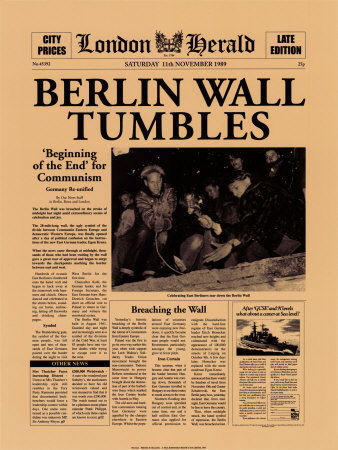
Today is the 20th anniversary of the Berlin Wall tumbling down. What a momentous event!
Most everyone remembers exactly where they were when they heard big-momentous news --such as when the twin towers came down on 9/11/2001, or when the Challenger blew up, or the Kennedy assassination (well I was barely out of diapers on that one...)
And I hate to admit that I barely remember the Berlin Wall tumbling down -- my own life at the time was tumbling down around me: my then-husband had left me and my 2-yr old daughter...
But life has a way of going forward, my life turned around, and my then 2-yr old daughter (Eldest) has just now returned from a month in Germany, full of stories "Berlin was my absolute favorite city -- it's the best party town, ever!"
Full circle. I've been to Berlin only once as a young adult, when I was around her age, and remember vividly the divided city: East Germany with it's graying buildings that still had bullet holes from WW2, the East German police with their guns and dogs when our train pulled into their stations, then crossing the border, giving way to colorful,
 lively, and yes "Party-town" West Berlin!
I heard on the radio this morning that for a few euros you can buy fake passports with East German transit stamps in them -- I still have one that's for real! Never would have guessed back then that someday it would be a souvenir of a bygone era...
Friday, October 30, 2009
Taxing sugar???

Americans eat (and drink -- in the form of sodas) way too much sugar: refined & high fructose corn syrup is showing up more and more in processed foods from breakfast cereals to salad dressings. In small quantities, these may be harmless, but the trend in our increasing unhealthiness among Western nations is alarming.
Obviously, just as it's not healthy for us to eat loads of fats, we should not consume all this sugar that's hiding in much of our food, and it contributes heavily (pun intended) to childhood obesity, heart disease, diabetes, etc. I wrote about this on a previous reflection post, entitled Diet is a Four-letter Word.
Recently, I got to thinking about something I heard on the radio one morning while barely awake when the alarm came on: a proposed tax on sugar in drinks, a penny per ounce on sugary drinks. Is that a good idea???
Pros
It would make us more aware of how much sugar we're consuming.
Some people would indeed change their habits.
The pinch in the pocketbook is not a hardship to the extend that sugary sodas are not nutrition we need: they're not "food" we need to sustain us (in other words, real food is not being taxed).
The money collected in taxes could be used for a good cause (education about dangers of childhood obesity, for example).
Cons

Diet drinks are not necessarily any healthier. Maybe they should be taxed too?!? For more info, here's more about the link between diet sodas, weight gain and diabetes.
Taxation for behavior modification is controversial -- would it really change behavior, or would people just start getting used to it after the initial "shock", and keep up the unhealthy habits..?
Would "natural fruit juice" start replacing refined sugar in most drinks, allowing manufacturers to charge a higher price, yet without significantly affecting the desired outcome, i.e. people still end up just as overweight on fructose as they do on sucrose...
Would the government end up being a "sugar police"? Is sugar the last legal drug...?
Hey, we're evolutionarily programmed to like sugar: we all know our early human ancestors had a better chance of surviving (and escaping the sabertooth tiger) if they found foods high in calories. But that's not the situation we're in, now is it?
I admit that I love dessert as much as the next person -- but I believe it should remain a special treat, rather than an abused substance!


Thursday, September 10, 2009
The Value of Education?!?
I couldn't believe how many kids were kept at home here in backwards Alaska on Tuesday. I guess their parents did not want their children to be exposed to President Obama's speech about this terrible socialist idea (namely the value of education,?!?!)
My son's High School history teacher didn't show it because it supposedly "did not have any relevance" -- what the @&F*%?
I had a school class on a fieldtrip at the Nature Center and the teacher said many stayed home because of the speech -- who knows, might we have piped the speech to them in the woods?
My daughter's 6th grade teacher taped the speech and showed it a day later -- good for him! Parents had the option of sending a note if they wanted to have their child to go to another classroom during the speech. I bet they would not have had to do that last week when our Republican governor spoke last week at a local school about the same topic...
SO, let me get this straight -- people kept their kids home to prevent them hearing Obama telling them to stay in school and work hard. I kringe at the message these parents are giving their kids: are they saying don't stay in school like Obama tells you to -- emulate Sarah (the Quitter) Palin instead...
Actually, come to think of it, there's one of those celebrity READ posters at my kid's elementary school with Palin in a dogsled holding a book, and the message is "READ A BOOK" -- how subversive!!! I better start writing nasty letters. After all, there's not many letters difference between Palin and Stalin! And if kids don't value their education, they may not be able to tell the difference...
Yikes, do they have any room in Canada...?
My son's High School history teacher didn't show it because it supposedly "did not have any relevance" -- what the @&F*%?
I had a school class on a fieldtrip at the Nature Center and the teacher said many stayed home because of the speech -- who knows, might we have piped the speech to them in the woods?
My daughter's 6th grade teacher taped the speech and showed it a day later -- good for him! Parents had the option of sending a note if they wanted to have their child to go to another classroom during the speech. I bet they would not have had to do that last week when our Republican governor spoke last week at a local school about the same topic...
SO, let me get this straight -- people kept their kids home to prevent them hearing Obama telling them to stay in school and work hard. I kringe at the message these parents are giving their kids: are they saying don't stay in school like Obama tells you to -- emulate Sarah (the Quitter) Palin instead...
Actually, come to think of it, there's one of those celebrity READ posters at my kid's elementary school with Palin in a dogsled holding a book, and the message is "READ A BOOK" -- how subversive!!! I better start writing nasty letters. After all, there's not many letters difference between Palin and Stalin! And if kids don't value their education, they may not be able to tell the difference...
Yikes, do they have any room in Canada...?
Sunday, August 30, 2009
Party-poopers
Warning, this is a bit of a curmudgeon-ly post: you've been warned!

Here I go:
At social gatherings (a.k.a. parties), I do not care to stand around listening to a bunch of guys "male posturing". Because to me, men bragging about their cars, fishing trips, business successes or anything else is just posturing -- they may as well be comparing the sizes of their dicks!
They just go on and on about themselves! No matter where the conversation leads --politics, science, the weather even-- this type of male (type A personality?) just likes to bring the conversation right back to himself and what a hotshot he is!
Myself, I rather go over and see what the ladies are talking about. I don't care about shopping, fashion or make-up, but more often than not, sooner or later they do get around to talking about some stuff is that close to my heart: children, education, family, health... But no matter what the topic, women tend to be more consensus-building, self-disclosing, yes, they're more likely to listen. Most importantly, they don't blatantly think of themselves as the center of the universe!
The question begs: is it all just basic Darwinian evolution at work? Men competing for power and access to females, while women are nurturing their young? Or did I spend too much time in graduate school taking courses in evolutionary biology?
Maybe I'm a bit biased -- just a teensy bit...
Phew, got that off my chest!
Photo credits
http://static.zsl.org
http://www.grg.org

Here I go:
At social gatherings (a.k.a. parties), I do not care to stand around listening to a bunch of guys "male posturing". Because to me, men bragging about their cars, fishing trips, business successes or anything else is just posturing -- they may as well be comparing the sizes of their dicks!
They just go on and on about themselves! No matter where the conversation leads --politics, science, the weather even-- this type of male (type A personality?) just likes to bring the conversation right back to himself and what a hotshot he is!
Myself, I rather go over and see what the ladies are talking about. I don't care about shopping, fashion or make-up, but more often than not, sooner or later they do get around to talking about some stuff is that close to my
 heart: children, education, family, health... But no matter what the topic, women tend to be more consensus-building, self-disclosing, yes, they're more likely to listen. Most importantly, they don't blatantly think of themselves as the center of the universe!
The question begs: is it all just basic Darwinian evolution at work? Men competing for power and access to females, while women are nurturing their young? Or did I spend too much time in graduate school taking courses in evolutionary biology?
Maybe I'm a bit biased -- just a teensy bit...
Phew, got that off my chest!
Photo credits
http://static.zsl.org
http://www.grg.org
Subscribe to:
Posts (Atom)