Tuesday, April 28, 2009

Barely posting, hanging in there!

It's spring in Alaska, and EVERY school class wants to have their nature fieldtrip during the last month of school - so I'm one busy Naturelady.

I may not be posting much these next couple of weeks, cause I'm outside every day, hiking with 100's of kids -- many of which love being outdoors ("This is best fieldtrip ever!"), but the occasional teen, like the one on a Wetlands fieldtrip yesterday in pink ballerina shoes (I kid you not -- the pictured slippers is what she wore) who said "I hate nature: it's so messy!"
Duh!

Sunday, April 26, 2009

Alaska fashion

At the Nature Center auction, I bid and won a SKHOOP!
What it is: a cross between a skirt and snowpants -- you can just wear it over pants, and stay nice and warm! Here are some pictures:


Read about this new fashion craze at this ADN article.

PS: real nice for coffee on the porch on a chilly but sunny spring morning!

Saturday, April 18, 2009

I'm a Rabenmutter Pyromaniac

Today I realized that to most Americans I'd be considered what Germans call a "Rabenmutter" (translated Raven Mother), which is not a compliment. Why? you may ask.

As to why a neglectful mother is compared to a raven has to do with the fact that fledgling ravens out of the nest appear helpless and abandoned by their parents, although in reality the ravens continue to feed their young until they're able to fend for themselves.
But nevermind the naturalist explanation -- what did I do to call myself a Rabenmutter?

Well, today was the second Saturdays in a row when I don't have to work, and I was in charge of chauffeuring youngest daughter to her Volleyball game, while hubby had a work-related engagement in Anchortown. So far so good, Youngest and I do some mother-daughter stuff like shopping (she got new shorts!) and then I drive her to her game. So far so good: last week I sat through 1.5 hours of watching her team play (I did bring my knitting).

For those of my readers who know me, you know that being a spectator at a sport is NOT something I enjoy (see my list of 20 Random Things about me) -- in fact, I make a terrible spectator -- I just fail to see the point of competetive sports.
So as I drove Youngest to Volleyball, I asked if she'd mind terribly if I missed some (half?) of her games if I went and got some exercise myself. She said, "No problem!", and I asked twice more if she really didn't mind, and she's cool with it. So I go exercise, which I haven't done in well over a week because my life has been so busy lately-- and the whole time I feel incredibly guilty -- only a Rabenmutter would do that! I hurry back, watch the second half of the games, and all is well -- but I just cannot get over how guilty I felt.

Maybe it's because when Eldest was young, and I was also very busy with 2 small children, I did not do much in the way of "spectating" -- in fact, it did not occur to me then just how important that was to her. I do regret now that now: she felt neglected in that respect. Now I understand that in the American culture, watching and cheering your children on is tantamount to good parenting -- it is EXPECTED that you be there! If you don't, then you obviously don't love and support your kid.!?!

Well, I do feel we're plenty loving and supportive, spending lots of time with our kids -- but it just isn't in the form of spectator sports. We're together almost all evenings and weekends, camp and hike a lot with them, probably spend more quality time with our kids than many sports-crazy families. Every evening we have lengthy discussions over dinner and when we gather as a family before going to bed, but on the outside, we're the parents that don't promote or support them in organized sports. But then the raven parents do take good care of their young -- it just doesn't appear that way to the outside observer.

And where does the pyromaniac come in, you may ask?
We burned some slash in the fire pit this afternoon, and I LOVE to burn slash! I really get into playing with the fire, and I was fascinated tonight when putting on branches from the big cottonwood that fell last fall. The buds were closed, but when I put them on the fire, the heat caused the buds to burst open, showing the green leaves briefly before the fire consumed them (it looked like speeded up photography)...
My clothes and hair smell of woodsmoke, and I love it. That's like perfume to me!

Thursday, April 16, 2009

The Little Book turns 50!

The Elements of Style by Strunk & White was first published 50 years ago today and has sold over 10 million copies. E.B. White, famous author of Charlotte's Web, was a student of Cornell University Professor Strunk, who first put down his rules for writing in 1918 in a self-published "little Book" also named The Elements of Style. White revised and expanded it after Strunk's death -- so much of the book is really more like 90 years old today!

Isn't it amazing that this classic is still in wide use today? The books appeal is surely due to it's simplicity and call for brevity. One of the most important tenets is "Omit needless words". What else can I say?

You can find an online version of Strunk & White at bartelby.com/141

Monday, April 13, 2009

Garden vs. Nature

I'm currently re-reading yet another Michael Pollan book (I've blogged about In Defense of Food and Omnivore's Dilemma, and my son just reviewed Botany of Desire -- all are excellent books I highly recommend). Don't worry, hubby, I don't have a crush on him (just google the author and you'll understand), but he's a darn good writer!

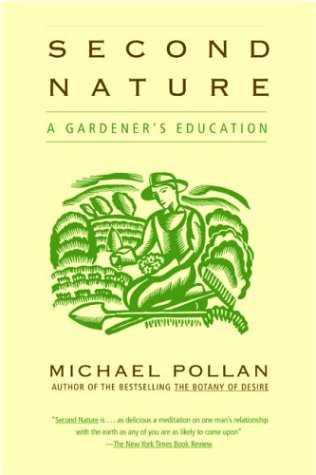
Pollan's Second Nature --a Gardener's Education is a sociological look at the relationship between humans and their attempts to control nature in their gardens. It's an interesting exploration not only to gardeners -- however, I find it's not quite as powerful a book as some of his others.
Pollan describes of his own influences, from his master gardener Russian-immigrant grandfather to his own father who refused to conform and mow his lawn, which made me reflect on my own influences -- I too had a grandparent who loved plants, and a father who saw yardwork as rather a chore (but was much more of a conformer). But perhaps an even stronger influence on me was my Onkel Max, who could be described as both a gardener and a true naturalist.

Max was not my real uncle, but rather, he and his wonderful wife, Hete, sort of "adopted" my parents when they arrived in Chile with their young family in the 1960's. Like many Germans there, Max's family had moved to South America several generations ago. Max really knew and loved nature -- he had bought a small plot of land in Granizo, in the dry countryside of central Chile. He and his family built a small stone cottage for a weekend get-away, and he planted an orchard full of apples, peaches, avocados, and citrus. Any agriculture in central Chile requires irrigation and hard work. What grows naturally around there are dry "bosques", full of such plants as the spiny espino. To most European immigrants, this ecosystem was just a worthless semi desert in need of "improvements", but Max loved this land.

I remember as a little girl tagging along with him when he checked on his orchard, plus the various cactus and other native plants growing around his place -- he had relocated some of them from where the orchard was planted. Max was also the warden for the adjacent plot of land belonging to the DAV (German Hiking Club), so we'd often wonder all over the woods, and he'd tell me about the plants growing there -- oh how I now wish I'd still have that actual knowledge -- I forgot that as quickly as any child would, but he did instill in the 5 or 7 year old that these plants and these ecosystems mattered.

Once a year, during the 4th of July equivalent, Chilean Independence Day, the German-Chilean community of the DAV had a large gathering for the "Spiessbraten", which is basically a feast of goat-roasting and beer-drinking. We kids loved this -- we basically were just free to run around all over, barely supervised. Moms were busy peeling potatoes while gossiping, making huge quantities of German potato salad, while dads were turning the spit over the fire (ahhhh, the smell is delicious) for hours upon hours while drinking quite a bit of cerveza and perhaps schnaps too.
I was roaming around the woods when I discovered our dentist, upstanding citizen and hobby gardener, digging up one of Uncle Max's prized native plants. The good(?) doctor tried to swear me to secrecy (it's only a local weed)-- but alas, I didn't feel this was right. Knowing how much Max cared about his plants, I reported the infraction, and Max promptly confronted the Doctor -- I don't think it came to blows, but it was a big deal! Max carefully replanted the stolen property, and probably told me how this plant may not survive having been dug up on a hot day during the growing season...

It was not only my first lesson in how some of the adults in my world can be less than honest, but also in the importance of respecting native plants and the ways of nature. And it it probably right there, in Granizo, where I started being a fledgling naturalist.

Max passed away in 1992, and it so happened that I was visiting Chile then, for the first time since my family moved back to Germany in 1970. My father and I had visited Max and Hete shortly before his death, and we attended his funeral. I visited Chile again about 10 years later, and spending time in Granizo (which now belongs to his son) is always the highlight -- somehow this dry landscape is still "home", and my image of "garden" is the fertile irrigated plot of land full of flowers, vegetables, grape vines and fruit trees in Central Chile.

Saturday, April 11, 2009

Guest Book Review

My son wrote this book review for his Science class. I too found this non-fiction book fascinating -- so with Wolf's permission, here's his essay:

The book The Botany of Desire is separated into four parts: Apple, Tulip, Marijuana, and Potato. Each portion was dedicated to the history of the plant and a philosophical exploration of its relationship with humans. The author Michael Pollan made many references to Apollo: the god of healing and medicine, and Dionysus: the Greek god of wine and the inducer of such emotions as ecstasy.

Michael Pollan began his book with a narrative about John Chapman (Johnny Appleseed) riding down the river on a canoe with a sack of black apple seeds at his side. His plan was to plant a tree nursery by each settlement that he passed. The fruit from those trees were not grown for eating; rather, they were destined for the production of hard apple cider. These small, bitter apples were known as “spitters”. The selective breeding of sweet apples did not start until much later. These farmers used a special technique known as grafting. The farmer would cut a twig from a desired tree and remove a small, wedged-shaped chunk of wood from another tree. Then he/she would place the twig into the other and bind it with twine. With the new branch attached, the tree would flourish and produce the desired apples.


The second section of The Botany of Desire was about the beautiful, vibrant tulip. The tulip was first cultivated in Persia. During the Middle Ages the Dutch incorporated the tulip into their culture. They grew a wide variety of tall, short, pink, maroon, and black. The most prized tulips in those times though, were striped. A virus known as Myzus persicae caused the rare pattern on striped tulips. The tulip actually consists of two colors: a base color and an added color (known as the Anthocyanin). Myzus persicae prevented the Anthocyanin from blending with the base color, resulting in the majestic striped tulip.

At the height of the tulip craze, some tulips (such as the “Semper Augustus” or the “Queen of Night”) cost as much as 1,800 guilders. In 1637, the “speculative bubble” burst: the tulip became worthless. The bottom fell out of the tulip market, and the once great flower that captivated the Dutch diminished to become the plain, ordinary flower that we call the tulip today.


The next chapter of The Botany of Desire was about Cannabis (Marijuana). The effect on humans of consuming this plant is a form of intoxication. THC is the active compound that causes this. THC specifically affects the cannabinoid receptors in the brain. The purpose of cannabinoids is not well understood, but it is theorized that cannabinoids filter the human perception of reality. Everything you sense every second of every day is not necessarily consciously processed. All that you are sensing is what you wish to sense, or require to sense in order to survive. The THC in cannabis is thought to imitate the cannabinoids in the human brain. This may actually be an evolutionary advantage. Cannabinoids may block out severe pain, unneeded memories, or useless sensory information.

From an ecological standpoint, why would a plant produce such a chemical? It is possible that, in the beginning, this chemical was used to ward off consumers such as insects or large animals. It is also possible that these plants have developed this chemical in order to attract growers. It has long been known that humans have had a desire to alter their perceptions of reality (such as young children spinning around in circles, alcoholic beverages, or illegally drugs.) And because of our craving for this, plants such as Marijuana may consider it in their interest to exchange the psychological effects of THC for the care and nurturing of humans.


The final chapter of The Botany of Desire was about the potato. This section of the book began with Michael Pollan contemplating the merits of his newly purchased genetically modified “NewLeaf”. This potato variety contains a gene borrowed from Bacillus thuringiensis (or “Bt” for short), which protects the plant from insects without the help of pesticides. The Bt gene is inserted into the potato either by injecting the plant with Agrobacterium, or literally shooting it with a small caliber rifle (the stainless steel bullets are dipped in a DNA solution). When Michael Pollan bought the NewLeaf potatoes he was specifically told not to plant new potatoes from the resulting crops; they were the intellectual property of Monsanto.

When Europeans discovered America, the potato was not valued. In fact, bringing the potato back to Europe may have even been a mistake. Either way, the potato arrived in Ireland and the rest of Europe in the 1500’s. Most Europeans did not like the potato even though the climate and soil proved able to sustain the plants quite well. The potato was frowned upon because it was foreign. It was thought that potatoes caused leprosy and immortality. But, because the subsistence farmers in Ireland could not grow many crops, they embraced the potato soon after its introduction. The poor Irish farmer discovered that with just a few acres of potato crops grown, they could feed a family. The population of these poor Irish increased until 1845, when the famous potato blight (Phytophthora Infestans) hit Ireland. The windborne fungus spores demolished the crops in only a few days. Even the potatoes in storage rotted. There was so little variety of potatoes, and no other crops to fall back on, that the disease was able to wipe out all the potato fields. The economic status of Ireland was so poor that the population was cut in half within a decade.

I liked most every aspect of The Botany of Desire. There were a few portions that were filled with tough vocabulary and complex philosophical ideas. I enjoyed the fresh new ideas that Michael Pollan presented and the way he presented them. The thought that flowers could have so much power over man or the immense consequences of potato monoculture are purely fascinating. This book was great to read because it answered many very deep questions and unveiled even more.

So is the long thought theory that we—humankind—are in control of nature? Are we truly in control of our apple trees, tulip gardens, Marijuana plants, or Potato crops? It would seem that since the discovery of farming we have never been in true control of plants. Rather, that they have been in control of us…

Tuesday, April 7, 2009

A violinist in the subway

You gotta read this story (Source: blog by Egodialogues). She writes this is an incredibly sad story which gave me chills. It is a social experiment about perception, taste and priorities of people.

A man stood at a metro station in Washington DC and started to play the violin; it was a cold January morning.
He played six Bach pieces for about 45 minutes. During that time, since it was rush hour, it was calculated that thousands of people went through the station, most of them on their way to work.

Three minutes went by and a middle aged man noticed there was musician playing. He slowed his pace and stopped for a few seconds and then hurried up to meet his schedule.

A minute later, the violinist received his first dollar tip: a woman threw the money in the till and without stopping continued to walk.

A few minutes later, someone leaned against the wall to listen to him, but the man looked at his watch and started to walk again. Clearly he was late for work.

The one who paid the most attention was a 3 year old boy. His mother tagged him along, hurried but the kid stopped to look at the violinist. Finally the mother pushed hard and the child continued to walk turning his head all the time. This action was repeated by several other children. All the parents, without exception, forced them to move on.

In the 45 minutes the musician played, only 6 people stopped and stayed for a while. About 20 gave him money but continued to walk their normal pace.
He collected $32.
When he finished playing and silence took over, no one noticed it.
No one applauded, nor was there any recognition.

No one knew this but the violinist was Joshua Bell, one of the best musicians in the world. He played one of the most intricate pieces ever written with a violin worth 3.5 million dollars.

Two days before his playing in the subway, Joshua Bell sold out at a theater in Boston and the seats average $100.

Joshua Bell playing incognito in the metro station was organized by the Washington Post as part of an social experiment about perception, taste and priorities of people. The outlines were: in a commonplace environment at an inappropriate hour: Do we perceive beauty? Do we stop to appreciate it? Do we recognize the talent in an unexpected context?

One of the possible conclusions from this experience could be:

If we do not have a moment to stop and listen to one of the best musicians in the world playing the best music ever written, how many other things are we missing?

For much more detail on this story, go to the April 8, 2009 Washington Post article "Pearls before Breakfast.